Showing posts with label student centered. Show all posts

03 February 2015

How Chemistry Explained Deflategate

I love Chemistry for a lot of reasons, but mostly because it helps explain the world around me.

In case you were living under a rock, during the AFC Championship game, it was found that the New England Patriots deflated their footballs by about 2 psi. The ensuing scandal was named Deflategate by the media. At a press conference, about a week later, the Patriots organization claimed that the rapid change in air temperature from their equipment room (approximately 72F) to the football field (approximately 47F) caused the pressure to drop.

A colleague (Mr. B) came to me and said that he saw a piece on a news channel that had Bill Nye the Science Guy facing off against a Harvard professor debating whether Chemistry was at fault for the pressure drop. It was very West Coast vs. East Coast like the Super Bowl was going to be. And, let's just say, that people need to stop doubting the genius that is Bill Nye.

Anyway, any good Chemistry teacher knows that the relationship between Pressure and Temperature of a gas is directly proportional so, technically, if the temperature went down the pressure would go down as well. But, any good Chemistry teacher will also tell you that what applies on one side of the football will apply on the other; meaning if the Patriots had this problem so would have the Colts. Ok, I digress again.

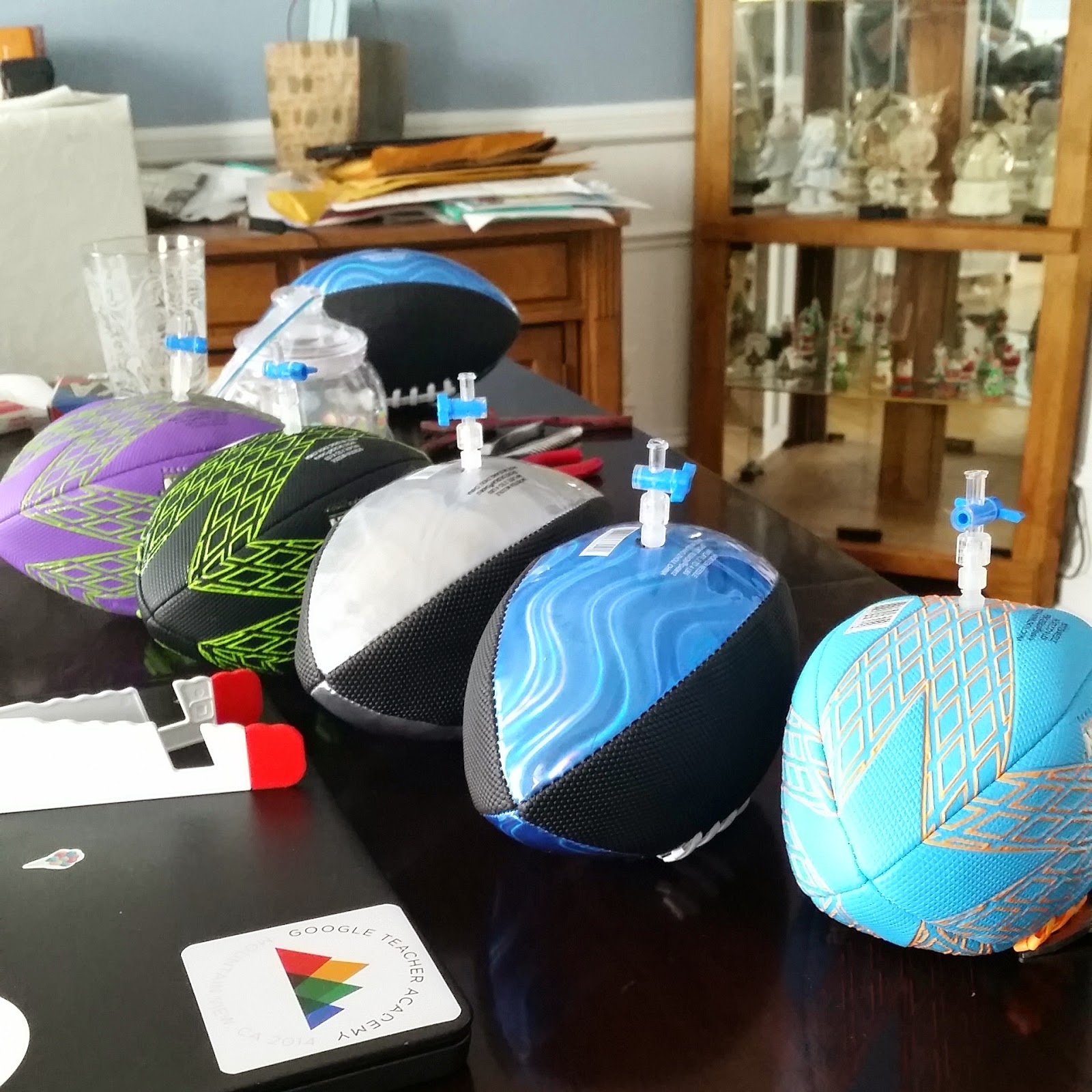
Mr. B and I brainstorm and come up with an idea about mounting a pressure gauge on a football and having the students immerse the ball in several water baths. We knew that the small change in pressure the footballs experienced wouldn't cause the almost 20% pressure drop caused at the game so we made the water baths go from over 100F to around 35F to have a more dramatic effect. After trips to Dick's Sporting Goods, Sports Authority, Five Below, Home Depot, AND Lowes, I found our original idea of simply installing a pressure gauge attached to a ball pin wouldn't work. I made some modifications and decided to add a Vernier Pressure Sensor to the footballs to give us better readings.  Here is a picture of the final setup:
This is the lab setup with the Vernier Pressure Sensor and Temperature sensor all attached to the football.
This is how I spent my weekend. Not pictured are the 3 footballs I destroyed trying to figure out how to remove the air valve. FYI, this was a lot harder than it seems.
I wrote up a lab experiment for the students to follow just so that we could have consistent results. I had some Gatorade containers like they have on the sidelines of football games for the hot and cold baths, and simply filled sinks for the room temperature baths. You can see the students holding the footballs underwater in each setup so that the air in the balls would actually change.
Room Temperature--approximately 23C

Hot Water--approximately 40C

Ice Water--approximately 5C
I ran the experiment with 6 groups in each of my 4 classes and NONE of the groups had more than about a 10% change in pressure and that was probably due to the fact that their valve was leaking and letting in water. We absolutely confirmed that Pressure and Temperature are directly related, but there was no way that only temperature caused the pressure in the Patriots' footballs to deflate.

Thinking forward to next year, there are a number of changes I need to make to the lab. First, my valves kept popping out which caused massive error. The valves definitely need to be sealed permanently into the footballs so that they can't leak. Second, I need larger containers for the water baths. Mr. B is going to try this with coolers instead and we think that will solve the problem. Third, since the plug on the football has a valve that will close to seal the air inside, I think I will have the students close the valve and move only the football to each station instead of moving all of the equipment. It became almost like a team-building exercise as they carried wires and probes and data measuring devices around the room.

Overall, this lab was a success. I loved that I planned this with a first year teacher. I loved that it had real world application. I loved that it was STEM driven. And I loved how it was real chemistry, but didn't feel that way to the students. It reaffirms my belief that we need less formal labs and more real-world activities for the students to be doing. I also love that it was messy because that's what learning truly is.

30 January 2015

Lucky Teacher

I have been very fortunate this year to have a fantastic group of students as well as a wonderful co-teacher. Every crazy idea I have had they have all supported 100%. I get up every day excited to go to work for the chance to work with these wonderful people.

My Honors students are exceptionally open-minded. I decided to do away with traditional notes for the Gas Laws unit and let them tell me what they know about the properties of gases. We spent about half of the block breaking through all the misconceptions they had about their world and it led to great discussions in both classes. Then we learned about the relationship between Pressure and Volume using pressure sensors and a syringe. They quickly understood the inverse relationship between the two properties and I was very satisfied with the lesson.

I planned on using the Gas Properties simulation from PHeT just to verify what they had discovered earlier using the pressure sensor. The sim was projected onto the board and I asked for a volunteer to go up and manipulate it. The student quickly figured out how to add gas and I asked the students to explain what they were seeing. The shouted out things like:
  • The molecules are constantly moving
  • They spread out to fill the container
  • They are all moving with the same speed
And while this is going on, the student at the board is playing with the simulation. She is moving the little man to change the volume and pumping in more gas. Well, that's the point where I was no longer needed in the room. The class began to yell out things they wanted her to do: raise the heat, lower the heat, pump in heavier things, blow the lid off, add tons of gravity. I had planned to use the simulation as the next class' lesson, but the students were so into what they were learning that I literally couldn't stop them. I tried to do it. TWICE. But I was completely ignored.

I sat down at a desk and snapped these pictures. 


Naturally others wanted a turn so we needed to rotate. I made whomever went to the board make a statement for the class to add to their notes on the topic. No PowerPoint, no outlines, no formal notes. In one block we covered an entire unit's worth of material. And the best part, every word is theirs. I told them nothing.

I am a really lucky teacher to work in a school that has amazing students that let me do the crazy things that I do.

22 November 2014

Reflections of TEDYouth 2014

I had the opportunity to take three members of my TED Ed Club to the TEDYouth event this past weekend at the Brooklyn Museum and it was a fantastic experience. For those who don't know, TEDYouth is basically a TED Conference, but attendees are entirely Middle and High School students and their chaperones. The theme was "Worlds Imagined" and every talk had the underlying message of 'You can do whatever you want in this life' and 'Your ideas matter.' There were about twenty speakers ranging from a 15 year old chef to an astrophysicist to a street dancer to a social photographer to a leech guy. At the bottom of this post you can see some of the pictures I took.

As with every conference, there were good speakers and some less-than-stellar performances. I wanted to discuss 2 of them in this post: Ruddy Roye and Flynn McGarry.

Ruddy Roye is a photojournalist who describes himself as a 'social photographer.' One of my students had the chance to introduce him on stage and he turned out to be my favorite speaker of the day.
During his talk, he explains how he feels it is his job to tell the story of the people on the street that he meets through his photographs. He said everyone has a story and we rarely make any effort to learn other people's stories.  There was one story he told that I wanted to relay to you. He said he was walking down the street and heard some men behind him catcalling at a woman that he realized was walking up from behind him. He let her pass and noticed that she crossed the street to stand in front of a door with a cross on it. He thought this was very odd so he followed her to ask why she was standing there. She turned to him and told him that it was Easter and for Lent every Christian was supposed to give up something. On that day, she decided to give up being a prostitute and Ruddy knew he needed to capture her image (unfortunately not pictured above). I was so completely taken by surprise that I actually lost my breath for a second. The story was so touching and the picture was beautiful. I highly recommend following Ruddy on Instagram (@ruddyroye) to see his amazing work.

The other speaker who had a great story was from Flynn McGarry who is a 15 year old chef. He started cooking when he was 10 because his father kept serving him beets and he very much disliked them. One day he was watching a cooking show and thought 'what if I cooked them like meat?' So he started using methods you would use on different meats to cook the beets such as smoking, grilling, barbequeing.
He found a few recipes that seemed to work and began to apply them to other vegetables as well. Instead of meat being the focus, he would use the flavors of the meat to highlight the vegetables. Then he asked his mother if he could hold a dinner party in their living room. The family kitchen couldn't keep up with his experimenting so he asked his parents to turn part of his bedroom into a kitchen (seen above). Eventually his home-based dinner parties expanded to restaurants in both New York and Los Angeles. During the activities session we had the opportunity to taste one of his creations. It was a smoked, grilled beet with a cranberry reduction and Greek yogurt. I am not a beet lover and I found it delicious!

But, the most important part of the day had nothing to do with sessions or activities. One of the reasons I love being an advisor is the opportunity to build relationships with my students outside of the classroom; to see them as young people instead of just students. Eating lunch with my students, hearing their ideas, joking with them, recording a stop-motion animation, watching the smiles on their faces as they got to experience a once-in-a-lifetime opportunity; these will be the memories from TEDYouth 2014 that will stick with me forever.

07 September 2014

First Day(s) of School

One of my unwritten goals for this year is to make a post every week. The idea that I want to pursue for the TED Ed Club is to help others see the awesome that is around them every day. The truth is I have awesome students and we do awesome things in the classroom so I want to share that with everyone.

This was the first week of school. My oldest son entered 2nd grade and every year he comes back and tells us he doesn't remember anything he did that day. When he entered Kindergarten, I remember him saying that the entire first day was him listening to his teachers tell the class the rules: where to sit, where to stand, when to talk. As he spoke all I heard was 'Sit. Stand. Speak. Good boy.' This year I vowed not to make class an obedience lesson.

The first day of school is a clean slate. I can be anyone I want. I can be the person I was last year or I can completely recreate myself. I chose the latter.

On the first day, I told my students that I didn't want to talk about procedures or grading or a syllabus. I talked about learning and my expectations for them and their expectations for me. I talked about my experience at the Google Teacher Academy and how it changed my life. I did a lot of talking, unfortunately, but they did a lot of smiling.

My classes are very different from each other. I think my Honors classes surprised me the most. I talk about my bungee chairs and how I encourage the class to make the classroom their learning space, to be as comfortable as possible. One of classes just stared at the chairs as if I told them they could sit on a bed of nails all class. My other class stopped me, asked if I was serious, and the second we broke for the activity, began pushing each other out of the way to get to the chairs. One student didn't make it so he sat on top of his group's desks, happy as a clam.

Colleagues came up to me on Friday and told me how their former students who have me told them how excited they were for my class. That makes me feel good, that they actually heard what I was trying to tell them. But on the 2nd day of class I wanted to be sure. I ran a PollEverywhere poll and asked "What was your biggest takeaway from last class?" Obviously each kid took something slightly different away, but here is a screenshot of my favorite:


I wasn't going for fun, but many realize that they will learn chemistry, they will learn new skills, and that they actually have to work. The ball is rolling and now I just need to keep this momentum going.

01 May 2014

It's All About the Benjamins

That's a Cheeto on fire!
I realized on my drive yesterday that I now have the mist dangerous classroom in the school. We have eliminated all shop classes so there are no more saws and drills presses to potentially remove an appendage.  Therefore the chemistry lab is one of the few places left where the students can be seriously injured. We use chemicals that can't be purchased except through special chemical companies.  We have acids, flammable substances, broken glass, hot metals, scalding water, poisonous chemicals and sharp objects.  And, I have labs in which I freely let the students mix these substances in whatever quantities they wish and I call it inquiry
learning.

And yet I really don't have discipline or safety problems. I don't have students misbehaving and running a muck in my room. And I have not written up a student for inappropriate behavior in over 10 years.  This doesn't mean my class is perfect, but I take a slightly different perspective on classroom management than a lot of teachers.

You see, my class is all about the Benjamins. And the Christinas. And the Jaimes and the Roberts and the Mohammeds and the Ericas and the Jordans and the Alexs.  Our class is all about the relationships.  Our class is about the mutual respect we have for each other.  Our classroom is where risk taking is rewarded and failure is learning.

Sometimes, as teachers, we get so wrapped up in lesson plans, state tests, and completing our curriculum that we lose sight of what who is most important in our classroom.

25 January 2014

It's Official!!!

I am sorry to be slow in updating this blog, but I wanted to formally write that we are an Official TED Ed Club!!!  It has been an amazing journey so far and it is only going to get better from here.

So now that I talk about what we are doing without putting the word "PILOT" in front, what does that really mean for the club?  Actually, not much is going to change.  We are still going to be a Community Impact Club (I think I need to copyright that phrase), but rather than having meetings centered around discussions, the students need to start putting their ideas into action.  The discussion format is being dropped by TED Ed so we are shifting to a presentation format--basically the students are required for creating their own TED Ed Talks.  My club is composed, primarily, of students who don't really talk much in class--great workers, just not stand-up/take control types--so I am particularly interested to see how this all develops.

We are also taking on a more formal training method to our meetings to get the students ready to give 10 minutes talks about what they are passionate about.  I have made modifications to the Idea Book that was given to all advisors so that it would work better to our club and my methods as an advisor.

Because we have grown so much over the past few months (7 students at our first meeting, 40 today) I decided to mix things up.  Each student was assigned a seat and given an index card with their name on it.  On the back they were to "Draw a picture of something they are passionate about."  We then discussed within our small groups what we drew and then a few members shared with the group as a whole.  Here are some of my groups' passions:


Some members have approached me in the last couple of weeks about projects they wanted to start so we shared their ideas and the videos that inspired them.  In the planning stages, we have:

1.  Gangster Garden--We are going to build a community garden for the purposes of not only feeding the community, but also improve the quality of the food provided by the school.  We also talked about using the food as a fundraiser for some of the other projects and reinvesting in the garden (possible greenhouse).  I think our biggest step was that everyone agreed to plant seeds and take them home to germinate as a way to get the garden going before spring arrives.

2.  Dumpster Diving for the Homeless--one student saw a talk on YouTube about a man who was collecting non-expired food from dumpsters behind supermarkets and was living completely off of this food.  After doing some research he found that supermarkets actually have a policy of throwing out the food rather than donating it to shelters simply for the ease of disposal.  He also found that clothing stores will shred clothing rather than donating them because they can't thrown them away if they aren't damaged.  We are not dumpster diving, but it will include trying to convince a lot of stores (supermarkets, bakeries, bagel shops) to change their policies to help those less fortunate.

3.  Look Up More--The first video we saw as a club was by Charlie Todd.  One of his projects was called "Look Up More" which basically focused on getting people out of their own head and to take a look around.  So, inspired by this photo
we are going to hang a variety of objects that catch the sunlight (cocktail drink umbrellas, small prisms, tissue paper flowers, etc) from the ceiling in the atrium outside of our media center.  The ceiling in that area is about 30 feet above the students and has large windows with a fantastic amount of sunlight streaming through.  On the floor we are going to put LOOK UP MORE in the hopes that student stop walking through the halls in a trance.

I will update again after our next meeting.

Small Update:  I forgot to post the pictures of our tentative plans for the projects.  We identified what we needed, who needed to be contacted, and where we wanted to do the project.  These pictures were taken with Google Glass.


23 October 2013

Best. Meeting. Ever.

We had another TED Ed Club meeting this afternoon.  These meetings always have 3 parts:  evaluation of our recent project, discussion about the newest TED Talk, and setting an agenda for the next meeting.  After school meetings are tough because so many students are involved in extra-curricular activities that they just can't find time for everything.  But, in the end, we had about 15 attend with a few of those arriving late.

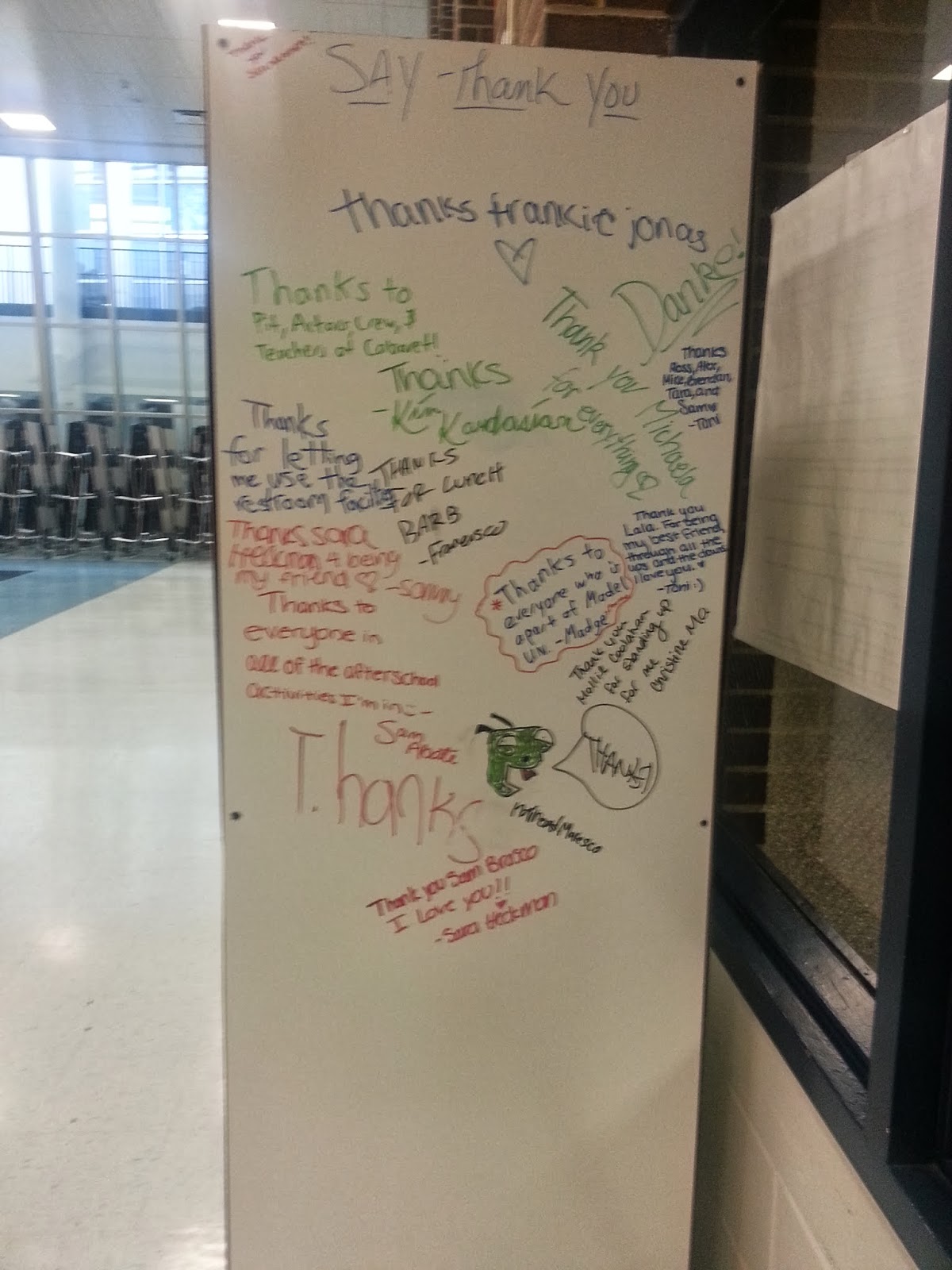
Our latest project involved what we were calling the "Thank You Wall."  Using the TED Talk by Drew Dudley as our inspiration, we decided to create a space for anyone in the building to say thank you to someone who had a positive impact on their life.  It was extremely well received as you can see from the pictures below.  The columns we created were 6ft tall by 2 feet wide so between the 2 of them there was 96 square feet of whiteboards filled with nearly 400 messages of thanks.


The project was headed up by one of our seniors.  He commented in the meeting that on one day he saw a girl glance up at the board, see a message that was written to her, and a huge smile broke out on her face.  He said right then it made all the planning and time worth it.

But what I really wanted to share was the discussion that ensued for the next hour.  The talk we chose was by Shawn Achor about what makes us happy.  There have been a lot of changes in our school/district, not all of which have been well received by the students.  I thought this video would be a chance for the students to get refocused on the important things in their life.


This discussion was intense!  I decided to try a new system and had the students write down their comments on post-it notes and stick them to their faces whenever they had something to say.  We have a tendency to get very passionate and talk over each other so this was a way for us to stay organized and keep track of our next comments.  Students had 3 and 4 notes stuck to their face, they are standing on desks trying to be recognized next.  Two girls who are best friends got into a huge argument over the ability to have selfless acts.  It was amazing!!!  I have never seen students debate so adamantly before over something that was, in reality, so trivial.

In this whole discussion, the students decided that we needed to have a better focus, a mission statement to guide us in our future meetings.  Here is what they came up with (I had no part in this at all!):

Objectives of the MiddSouth TED Ed Club:
1. Make a positive impact on the school community
2. Do something to benefit others
3. Change the way people treat each other.
4. Create a bonded community.
5. Make a change in ourselves.
6. Do something that other schools don’t.
7. Provide a forum for unique ideas that have nothing to do with what happens in the classroom.
8. Put ideas into action.
9. Bring our ideas to younger kids.

In all the years I have been an advisor, I have never seen a group of students so excited at a meeting. I can't wait until next week's meeting and I wish it wasn't only 30 minutes long.

09 April 2012

Flipping my Flipped Classroom

I ran into some problems last week as the marking period was drawing to a close.  Lots of stressed out students who were not good about time management were cramming assignments in at the last second.  One of them even exploded in class almost yelling at me, saying that she used to look forward to my class and now she hates it because of the flipped classroom.  Time to do some serious reflections.

Now, why is it that great ideas seem to come when you don't have access to pen and paper to jot them down?

Of course I am in the shower when I had an epiphany.  Actually it was a series of ways of how I can change the structure of my class to make this method work better for everyone.

  1. Change the structure of the room--I think part of the problem with allowing the students to structure the room is they work with people that are at their level in the material and so have no one to really turn to when they get stuck except me.  If specific parts of the room are focused toward different types of work, it will create more heterogeneous groups.  Three lab benches will be dedicate to lab work this way I don't have to worry about constantly setting up and tearing down labs because all of the necessary equipment will already be there.  The place that students typically need help the most is on homework and review sheets so 1-2 benches will be dedicated for this purpose.  If all of the students at the bench are working on homework, they will give them a better chance of getting immediate help.  This will now leave the desks space for general purpose or test taking.
  2. Redesign the videos--The videos mimic my previous lecture style:  a bit of notes followed by examples the illustrate the content.  One student this year is tried to complete the entire marking period without watching the videos and learning everything from the homework problems or other students.  This got me thinking that maybe the examples don't need to be in the video with the content.  So, the main videos will be strictly content with all examples problems moved to separate videos (think video 1a and 1b to keep them connected).  This will give me more time in the videos to explain content and throw in some animations or other short video clips as illustration.  The videos will also be a lot shorter.
  3. Standard-based assignments--while I started to make this change this past marking period, all it really do is make it clearer what objective the assignments are linked to.  However, I don't feel I could really say whether a student mastered an objective based on the results of the assignment.  So, homework and test questions will be focused on specific objectives first and then have some integrated problems at the end.  Each assignment will also be broken down into smaller sets with fewer points.  They will add to the same in the end, but this will allow me to evaluate them more frequently and give better, more specific feedback prior to final assessments.  
  4. Tests--The tests will also have a radical change to them.  The fact that tests take an entire period really hurts the flow of the class.  Tests will be broken up into 3 parts of 15 minutes each to allow them to be taken over the course of the entire unit.  What does sitting down for a 45 minute stretch of time at the end of a unit really prove about their ability to take a test?  That they can recall information they learned 3 weeks prior?  Since the questions will be focused on specific groups of objectives, as soon as they feel they have mastered the objectives, they can sit for that portion.  If a student wants to take multiple or all of the parts on the same day, so be it.  I used to think that tests were a great way to prepare students for midterms/finals, but how does a 45 minute test on 1 unit really prepare them for a 2 hour semester examination?  I'll let the other courses prepare them for that.
  5. Weekly progress indicators--The number one complaint from the student who hated my class is that she couldn't manage her time properly and needed me to tell her what to do.  Now, I still give the assignment chart which details all of the "due dates," but she needs more.  So each week the students will receive a grade out of 5 based on their completion of assignments/objectives.  If they are on track, they get a 5; if they are behind they get a 0.  I know this is a little unfair, but carrots can be great motivators, especially little ones like this that will add to be about 2 homework assignments by the end of the MP.  Now, unbeknownst to them, the grade will not be averaged into their MP grade, but will still be visible to them and their parents.  
I don't know if any of this will work.  But, what I do know, is what I am doing isn't working for everyone.  Sure most of the class has said how much they enjoy what we are doing, but the ones who don't really, really hate it.  Changes need to be made for that latter group.

I would love to hear thoughts/comments.  Any help you can give is greatly appreciated.

09 March 2012

Flipping over assessment

Not to give away part of my presentation for the Flipped Class Conference in June, by I have to talk for a minute about how assessment has changed in my class.  While there are still the typical assignments (HW, quizzes, tests, labs) I have tried to not only make everything objective-based, but also put some sort of inquiry into as many as possible.  This has been the most fun in my recent 5pt quizzes.

I have always used my quizzes as a way to do a quick check for understanding and to keep the students studying the material throughout the unit instead of the night before the test.  When I started the last unit I was looking at the typical problems I put on the quiz and decided that it bored me to even type them up in the first place.  The problem was a Boyle's Law problem (Pressure and Volume are inversely proportional) and I remembered I had this great demo involving shooting a slug of potato across the room.  So, I told the students to take out a half sheet of paper, did the demo (spraying potato everywhere) and told them to explain the demo using what they knew about gas laws.  The entire class got a perfect score.  But the best part was they had fun for that quiz.

So we are now in the Solutions unit and I needed to come up with a good quiz question.  I focus heavily on making solutions and what better way to demonstrate that you can make a solution than by making pink lemonade.  I told my students they were to calculate and write out the procedure for making a solution that was no less than 1.0 in concentration (Molarity or molality was up to them) and then make the solution.  They jumped right into it and immediately did it wrong.  They didn't know they were wrong when they did the calculations because everything looked perfect.  It was when they went to make the solution and overflowed the cup that everything became clear.  What students typically forget is that when you add solute to solvent the volume increases.  Easy to say, but better to experience.

One of my best students gets a 4/5 because of this and begins to negotiate with me on how he can earn back the lost point.  So I looked at him and said that if he can figure out the concentration of a solution made from directions on the back of the container, he could have his point back.  And off he went.  15 minutes later he is back with all of his calculations.  The reason this was challenging is the measurements are in fluid ounces for the total volume and tablespoons for the powder (which we assume is just sucrose), neither of which are units of measurement we use.  I look at his calculations and notice that he had converted everything to grams and milliliters.  As soon as I open my mouth, he interrupts with "I Google'd the measurement conversions that I didn't know."  Well, it turns out that pink lemonade has a concentration of about 0.237M.

The key to this story is that when you move to the Flipped Classroom everything is about the conversations. There is no question that this student understands the material.  Sure I could have given him a traditional written quiz and he probably would have earned the same grade.  But he was far more engaged and will probably remember what he learned from this experience far longer than doing some problem from a textbook.

23 February 2012

This is why I do the Flipped Classroom

I have been running the Flipped Classroom on and off for over a year now and while I have seen many successes, what happened yesterday really demonstrated how, when you structure it right, it really works.

My Honors Chemistry class is just the perfect combination of students:  energetic, open-minded, willing to try, outside-the-box thinkers.  I have been including more inquiry labs in their units, something I was definitely lacking in previous attempts at this.  In the one they are currently working (Gas Laws), I asked them to create a lab that measures the amount of CO2 produced in the reaction of Baking Soda and Vinegar and compare that to the theoretical value that should be produced.  We are getting a lot of great ideas on how to measure the gas (measuring the volume of a balloon, water displacement by immersing the balloon in water, water displacement by bubbling the gas through water), none of which I suggested to them, all of which have had different results.

Since the materials where already out for the lab, I did the following demo for a group of the students trying to get them to explain it with gas laws.
After they came up with a good explanation, another student chimed in with "So can we do the opposite to get the balloon out?  Could we heat the flask and see if it inflates the balloon above the flask?"  Well, who am I to stop them?  So they set everything up and sure enough it pushes the balloon back out.  Unfortunately, because the mouth of the balloon can't hold on tight enough the balloon pops off.

So the same student says, "What if we blow the balloon up a little first, put it on the flask, and then heat it?  Could we get it big enough to pop the balloon?"  I stepped back, took a seat on my stool and got out of their way.  In hindsight, I wish I had my video camera ready.  The balloon got pretty big, but eventually the gas in the balloon hits an equilibrium point and the water condenses.  The balloon never popped because the gas pressure doesn't get high enough.

Now the door has been opened.  Today the students rushed in trying to do it again with a bigger flask and more water.  Then they did it with the same amount of water, but a smaller flask.  Then they tried with heating the baking soda and vinegar lab.  Nothing popped the balloon.  Now, while my lab benches are now white with baking soda and the room has a severe vinegar smell, if I had to do it all over again I would.  It was the greatest 2 days of unadulterated learning I have had in my career.

This is why I do the Flipped Classroom

03 February 2012

A great day


I had a really good day and I want to share what my students did today.  I was at #educon this past weekend and was fascinated by the focus on Problem Based Learning throughout the school.  The problem that I have been having is getting over the traditional methods of how I was taught and break out into the PBL world.  If it was Bio or Physics, I think the transition would be easier, but Chemistry is a different animal.  There are certain parts of the curriculum that needs to be taught by direct instruction, and yet SLA is doing it by PBL.  So, while there I picked the brain of a couple of the teachers and they really inspired me.  So, today it happened.  Let me describe the activity.


We just started the Gas Laws unit.  The best part of gases is it has a lot of real-world connections and tons of ways to demo the different properties.  So, I rearranged my room (on the right) to mimic a rigid container.  Then, as the students came into the room they picked a colored index card that had either H2, CO2, Scribe or ? on it.  What I wanted was someone to keep notes for me (Scribe), a gas with low mass (H2), a gas with a high mass (CO2), and then some added molecules that can be throw in when I needed to increase moles.

There are four properties that we needed to focus on:  Pressure, Volume, Temperature and moles.  I had the Hydrogen students jump up into the center and explained that gases act like billiard balls on a pool table.  Every time they collided with a desk they were to pat the desk to simulate pressure.  The students at the desks were to record every time a gas molecule collided with their desk.

My biggest concern is to keep the students moving at the same pace.  A brilliant friend of mine recommended that I find an online metronome and to have the students moving one step per click.  The metronome then doubled as my temperature because it was easy to increase or decrease the clicks which changed the pace of the students.

So, on to the activity.  The students wanted to compare pressure and temperature first so I started the metronome and they started bouncing around.  Slowly I increased the speed and watched a little bit of mayhem occur as the students continuously crashed into each other.  About a minute later I stopped and had the students sum up what they observed.  Immediately they saw the connection between the speed of the molecules and the rising temperature.  The students at the desks saw immediately the connection with pressure and several threw out that they were directly proportional.  I then started the molecules moving again but began slowing down the metronome to simulate the temp dropping.  It didn't even take the full minute before my pressure students said that they saw a decrease in hits.  One student even commented that not a single molecule struck his desk in the minute.  Of course, my scribe is writing the notes on the board based on her classmates comments.


Next they wanted to talk about moles so in come the ? students.  There were 9 in the middle and now there were 12.  Again, the pressure connection came out immediately.  Besides colliding with the desks more often, they commented that they felt that there was more chaos in the vessel as they collided with each other more often as well.  This demo was a little self-evident, but was important to reinforce visually.

So now came the tough part:  inverse relationship between Pressure and Volume.  When I was first planning this, I couldn't figure out how to make the volume change.  And then it dawned on me: moved the desks!  My desk students slid in the short ends and the gas students kind of panicked.  One asked where they were supposed to move, "we're collide with everything so much."  Did I just hear understanding?  So as volume decreased, sure enough the pressure increased.  My direct relationship student from earlier jumped right in to offer up the inverse relationship between pressure and volume.  

We are more than halfway through the period and the Carbon Dioxide students are tired of sitting and watching their classmates having all of the fun.  So Hydrogens sit and the heavier gas molecules step up.  But, there was a catch.  I needed to demonstrate to them how the heavier gas will exhibit slightly different properties because of the added mass.  Well, I can't make the students weigh 2200 pounds (CO2 is 22 times heavier than H2) so I load up every student with every backpack, book, purse, you name they had to carry it.  With Pressure still as our focus I changed the temperature and watched the heavy gases struggle to move around the "container."  Now the questioning here needed to change a little.  We needed to see the effect on pressure from the perspective of the gases versus the container.  The container noted that they saw no real difference in the collisions they were experiencing.  The gases, on the other hand, mentioned that they felt they were colliding a lot harder with both the container and other molecules with greater force as the temperature increased.  Combining the speed and the added mass definitely had an impact on the overall results.

This ran us pretty much to the final bell so I didn't have a chance to talk about how the students felt about the activity.  I tweeted with some students later and they commented that they really enjoyed class today.  I have to say that I had a blast.  It was so much fun watching the students physically demonstrate the concepts for the unit they were studying.  Those students who like the more formal notes still have all of the podcasts posted on my YouTube channel so no information is lost.  

Overall, I definitely want to do this again.  Could I do this every day like this? No way.  But, it definitely makes me question more of my semi-traditional methods for instruction.  Labs will need to be restructured so they start the unit and more information can be drawn from them instead of the labs reinforcing what I have already taught.

Sorry that this was so long, but I wanted to describe as much as I could so you could get a better feel for the lesson.  I would love to hear your thoughts on the lesson and your experience in PBL.


27 January 2012

EduCon Philly Day 1

I just finished up my first day at EduCon and I needed to share some of the amazing things that I saw.  I could go on for a very long post, but I want to group everything into three categories.

Leadership
If you have ever heard Chris Lehmann speak, you know immediately that he is an amazing educator.  But I want to talk about how he runs leads the school.
  • Food
    • There was food and drink everywhere.  I went into one classroom and I would say at least 2/3 of the class had some sort of drink bottle on their desk.  And yet, for some reason, this didn't seem to disrupt the learning that was happening and there wasn't a bug to be seen. (sorry, couldn't help the sarcasm) But what really struck me was lunch.  As we are on our tour, we noticed 6 students sitting and eating in a Spanish classroom and there was no teacher in there supervising them.  The students eat EVERYWHERE--hallways, lunchroom, classrooms, window ledges--you name it, there were students eating there.  The best part about it was the kids had the utmost respect for their environment.  When the lunch was over there wasn't a single piece of trash to be found and I didn't see a custodian anywhere.  Whether they were in the classroom or the hallways, these kids loved their school and it showed.
  • Computers
    • Every student is issued a Mac laptop when entering the school and they must pay an insurance fee ($85) every year to keep it.  Most of the computers were decorated with stickers, drawings, quotes written in Sharpie.  Most schools would freak out if the kids were "damaging" school property, but not this school.  They trust that the students will respect the computers and the students respond.
  • His Office
    • It is not often that I am caught like a deer in the headlights, but this one really threw me.  I was walking passed an office and a student I met called out to me from a conference room in the back.  I noticed a number of students in both the front office and the back conference room (probably 15 or so).  As I walk into the office, Chris Lehmann is sitting at his desk laughing with the kids around him.  That's right, I walked right into the principal's office without realizing it.  I was stunned by the fact that he welcomed me right in as if it was no big deal.  Now, let me mention something else about the office.  Chris' desk is where the secretary should have been and the larger space was used as a place for the students to congregate and eat or get work completed.  Anyone else have a principal like that?
Teaching
  • Teaching Philosophy
    • Everything is done for the kids.  There was no talk of working within the contractual time.  Everyone put all of themselves into building dynamic classrooms that were student-focused and learning by doing was at the heart.  Students talked just as much as the teachers did and the lessons were engaging.
  • Attitude
    • Everyone smiles.  Everyone wanted to be there, staff and students alike.  Students were helpful because they wanted to be not because they had to be.  Teachers gave up lunch time to sit and converse with visitors because they are passionate about what they do and want to share it with everyone.

Students
  • Passion
    • I need to tell you about Maggie.  I was wearing my infamous neon green tie, and after watching Diana Laufenberg's class, Maggie comes up to me saying how much she loves my tie.  She is going on and on about it and how I have to wear it for the entire weekend.  Later in the day, I am walking through the halls with a friend.  Maggie is about halfway down the hall and starts waving at me the second she saw me.  Then, at the end of the day, Maggie is the student who called out to me from Lehmann's conference room.  She comes running through his office and gives me a big hug right in front of him saying that we are friends now so it is OK to give me a hug.  That's passion.
  • Dedication
    • Every kid we asked questions of stopped whatever they were doing and gave us their full attention.  Most of the kids used their lunch time to collaborate with peers on a variety of projects.  None of the kids seemed stressed about anything they were working on and were eager to share their ideas regardless of what the topic was.  Even in the history class I saw, the teacher encouraged the students to make comments on a New York Times education page about the State of the Union, and she showed that one student in the class had already done it before being asked.  
What makes this school so successful is the fact that the entire school takes on the same mindset.  There is a culture of learning in everything the students do and it permeates into everything and buy in from staff, students and parents.  Every school could be like this if they wanted to and change the culture to make it happen.

09 January 2012

25 hours in a day

That's pretty much the minimum amount of time I need to get everything done that I am working on. There will be a post about the alternative assessments my students just completed, but I need to grade them first.  So, let me tell you about a little things called the Middletown Web Challenge.

In November, a friend's school ran a 30 Web Tools Challenge in which they posted a different web tool for each day for teachers to try in their classroom.  The objective was to expose teachers to a variety of free tools that could have an immediate, positive impact on learning.  There are so many teachers that want to do more in their classes, but don't have the time or know-how to find the way to improve.  Your colleagues can only provide you so many ideas and once you have been teaching awhile with the same group, you find the ideas begin to dry up.  This is where the web challenge comes in.

My district is on the edge of glory greatness.  For too many years, because of a rotating door of administrators, the teachers have shut their doors to the outside world and things have begun to stagnate.  That does not mean it's bad; in fact I have met some amazing individuals.  The problem is the school is at the point where it needs that small push to get from good to great.

http://www.melroseschools.com/images/digital-learning.jpg
I saw a tweet from Eric Sheninger in December about Digital Learning Day on February 1st.  This initiative from the Obama administration strives to increase the amount of technology being used in schools with the kickoff occurring on DLD.  I saw this as a fantastic opportunity to expose my colleagues to the wonderful world of Web 2.0 Tools that I have been learning about on Twitter for the past 2 years.  I shared the information with a colleague in one of our middle schools and she jumped on board.  Also a web geek, she has been leading a charge to incorporate a number of Google Apps into the MS classes so she thought this was the perfect way to start effecting real change district wide.  We met with our principals and so the Middletown Web Challenge was born.

This was all prior to Winter Break. As we began to build the blog and compile the list of tools we wanted to share, we realized that no one has really told the new superintendent what we were up to.  We scheduled a meeting for last Friday, and after the assistant superintendent heard of our plans, she immediately decided to make this a 6-12 initiative that would now include 3 middle schools and both high schools.  It was decided that a video promo of the project would be filmed to be put on the local TV channel and the district website explaining what we would be doing over the month of February so the community could get involved.  From a short tweet and subsequent email, this idea has grown into a massive district changing program.

I have to tell you that I am unbelievably excited for everything that is happening.  Regardless of how many teachers actually participate, I know that the group of teachers that are working on this project are striving to improve education and doing what's best of student learning.  When I first pitched this to my principal I thought that only my 1 school of 100 staff members would be involved and probably only about 25% of them would actually participate.  Now, this blog idea will be at the core of a movement that could involve 400 educators from grades 6-12.

I highly recommend getting your school involved in some sort of digital learning initiative before the end of the year.  Check out the links I included above for ideas on how your school can get involved.

21 December 2011

Another chapter in the book of crazy

I've decided that if I ever have the chance to (and motivation) to write a book, that's what I am going to call it.  Sometimes my ideas are just too crazy to be believable.  Let me tell you what I did this week.

I flipped my honors chemistry class for the previous unit and it went exceptionally well.  The students seemed very eager to try a new method and were so supportive of everything that we tried.  I went back to a more traditional method for the current unit, and since I really wanted them to see the difference, I went really traditional.  Lectured for the majority of class, went too fast without a lot of examples, and did labs that did not have a clear objective.  Problem was I HATED IT!!  It was torture using a method that I had just proven does not work.  I felt so so bad for my students having put them through a week and a half of hell.

I am sitting down to write the test on Monday night and I realized that since my teaching methods had been so low level, my test was going to be almost all recall.  We made very few connections between the material which would virtually eliminate all ability to write critical thinking questions.  So, completely on a whim and not really thinking it through, I sent the following email to my students:

"During this marking period I have flipped the classroom, let you make s'mores, and made you make apple pie out of saltines.  So, why not continue the crazy behavior.  I have decided that I have no interest in giving you a "test" on Atomic Theory.  I didn't want to give it on Thursday, but since I wanted to have some fun this week, that's the only day left.  To be honest, I have been struggling with the idea of major assessments all year, hence the reason I have been making things more objective based instead of assignment based.  This unit has had three objectives:

1.  Explain where radiation comes from and why it is important to the understanding of the atom.
2.  Compare and contrast the models of the atom and explain why the Quantum Mechanical Model is the theory we use today.
3.  Identify an element based on either its electron configuration or orbital diagram.

The problem is I have to have some sort of formal assessment to prove that you have met the objectives, but I don't want to give a test.  So, I am going to let YOU decide how YOU want to prove YOU understand the material.  I am going to put no restrictions on you other than whatever you decide on must demonstrate understanding of the above objectives.  I know that some of you are freaking out right now because you have no idea what the hell I am talking about or what you are going to do.  Random ideas that are going through my head are podcasts, models, drawings, make your own test, interpretive dance, make a review game, develop a class activity, act out a skit....um I'm out.  I don't care what it is as long as it is yours and it demonstrates the above objectives."

The reception has been mixed.  All are relieved that there is no "test" this week with all the other things going on in other classes (1 student said she had 4 tests scheduled for Thursday) and this allowed them to relax a little in such a stress filled week.  But, when faced with the idea that they have to come up with their own method for demonstrating understanding, most are very concerned.  Now the ones who are embracing this and starting early have had great ideas.  A group of 4 are making a music video, 2 girls are doing an interpretive dance (totally was joking about that in the email, but they love the idea) and 1 is going to make her own test.  

They have 2 weeks to figure this out and I am excited/nervous to see the results.  

So, was this crazy enough?

24 October 2011

I love it when they get it

I introduced the Mole today in my Honors Chemistry class.  For those of you who don't remember HS chemistry, the mole is a generic term that represents a specific amount of a substance, specifically 6.02x10²³ of a substance.  To put the size of this number in perspective, if you were to collect 1 mole of pennies and distribute those pennies equally to every human on the planet, each person would receive approximately one TRILLION dollars.  It's a lot of stuff.

My honors class is unlike any class I have in that they try to distract me from teaching by asking me complex questions related to the topic.  So, after I shock them with the above example, one student starts asking if you laid the pennies end to end, would it stretch around the world.  I said it would probably stretch around the world a few thousand times.  This answer was not acceptable for her so I told her to get the netbook out and look it up; Google the dimensions of a penny and the size of the Earth and figure out how many pennies you would need.  Just to prove me wrong, she rushes over, grabs the computer and is off working for the next 15 minutes.  (FYI, I was way off.  1 mole of pennies would wrap around the Earth approximately 899 TRILLION times)

After a few minutes I am talking about how to calculate the mass of 1 mole of a compound and a different student wanted to know how many moles of water are in a human being.  Not knowing how much water is actually in the human body, I told her (surprise, surprise) to Google it.  She picks up her iPhone and starts her search.  Unfortunately she ran short of time and energy before she could figure out an answer.  Turns out they only have percentages of water content listed on sites and not grams.  We needed a bathroom scale to actually measure someone's weight.  Guess what I am bringing in tomorrow!

I don't really care if they can calculate the number of moles of sodium in a sample.  What I do want is for them to be inquisitive, to know that they are free to ask questions, to know they are free to ignore me and work on something that has more meaning for them.  I want more days like today.

Moving Day

I want to thank everyone who has been reading this blog. It is time to get a more professional look to the site so this blog will be moving ...