Showing posts with label gas laws. Show all posts

03 February 2015

How Chemistry Explained Deflategate

I love Chemistry for a lot of reasons, but mostly because it helps explain the world around me.

In case you were living under a rock, during the AFC Championship game, it was found that the New England Patriots deflated their footballs by about 2 psi. The ensuing scandal was named Deflategate by the media. At a press conference, about a week later, the Patriots organization claimed that the rapid change in air temperature from their equipment room (approximately 72F) to the football field (approximately 47F) caused the pressure to drop.

A colleague (Mr. B) came to me and said that he saw a piece on a news channel that had Bill Nye the Science Guy facing off against a Harvard professor debating whether Chemistry was at fault for the pressure drop. It was very West Coast vs. East Coast like the Super Bowl was going to be. And, let's just say, that people need to stop doubting the genius that is Bill Nye.

Anyway, any good Chemistry teacher knows that the relationship between Pressure and Temperature of a gas is directly proportional so, technically, if the temperature went down the pressure would go down as well. But, any good Chemistry teacher will also tell you that what applies on one side of the football will apply on the other; meaning if the Patriots had this problem so would have the Colts. Ok, I digress again.

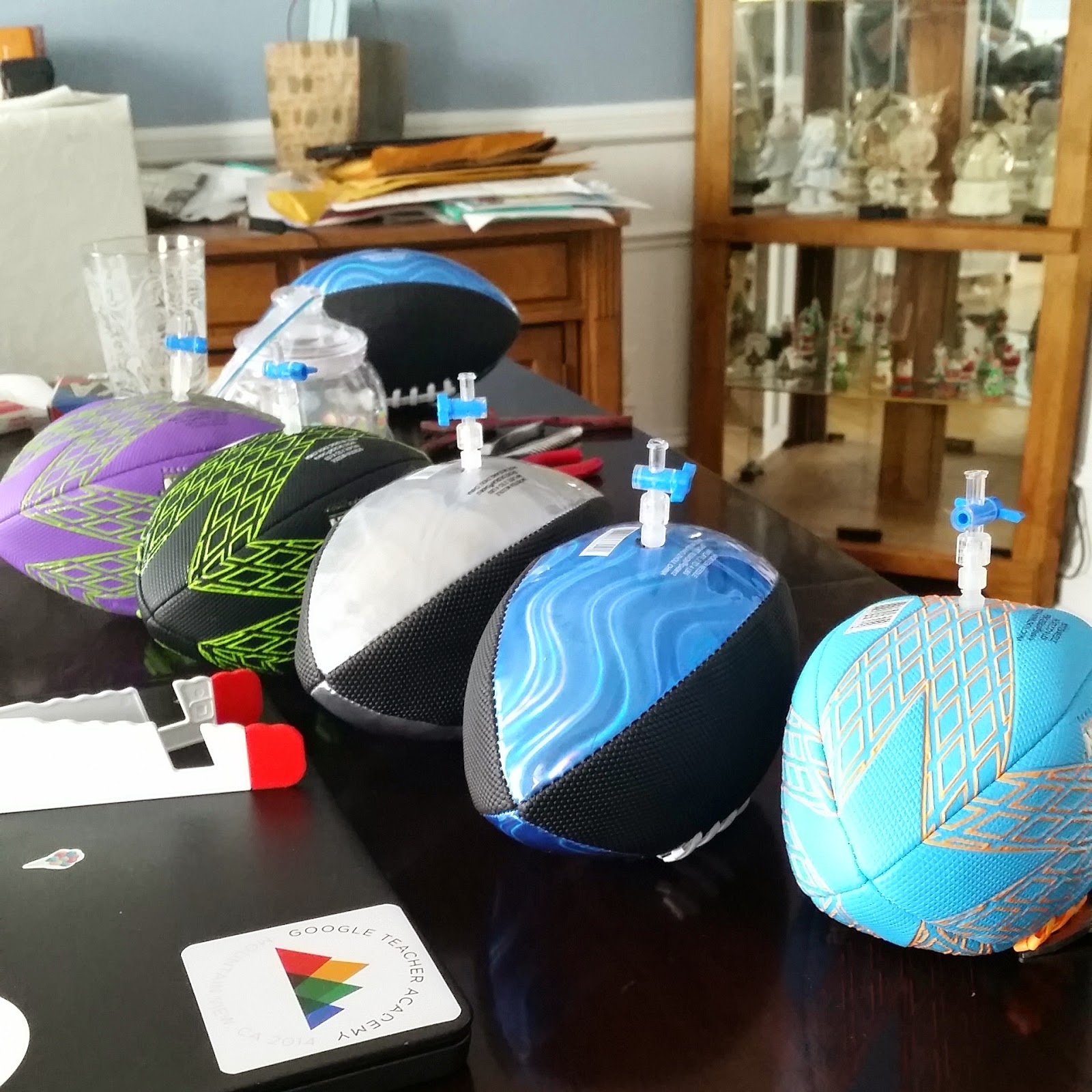
Mr. B and I brainstorm and come up with an idea about mounting a pressure gauge on a football and having the students immerse the ball in several water baths. We knew that the small change in pressure the footballs experienced wouldn't cause the almost 20% pressure drop caused at the game so we made the water baths go from over 100F to around 35F to have a more dramatic effect. After trips to Dick's Sporting Goods, Sports Authority, Five Below, Home Depot, AND Lowes, I found our original idea of simply installing a pressure gauge attached to a ball pin wouldn't work. I made some modifications and decided to add a Vernier Pressure Sensor to the footballs to give us better readings.  Here is a picture of the final setup:
This is the lab setup with the Vernier Pressure Sensor and Temperature sensor all attached to the football.
This is how I spent my weekend. Not pictured are the 3 footballs I destroyed trying to figure out how to remove the air valve. FYI, this was a lot harder than it seems.
I wrote up a lab experiment for the students to follow just so that we could have consistent results. I had some Gatorade containers like they have on the sidelines of football games for the hot and cold baths, and simply filled sinks for the room temperature baths. You can see the students holding the footballs underwater in each setup so that the air in the balls would actually change.
Room Temperature--approximately 23C

Hot Water--approximately 40C

Ice Water--approximately 5C
I ran the experiment with 6 groups in each of my 4 classes and NONE of the groups had more than about a 10% change in pressure and that was probably due to the fact that their valve was leaking and letting in water. We absolutely confirmed that Pressure and Temperature are directly related, but there was no way that only temperature caused the pressure in the Patriots' footballs to deflate.

Thinking forward to next year, there are a number of changes I need to make to the lab. First, my valves kept popping out which caused massive error. The valves definitely need to be sealed permanently into the footballs so that they can't leak. Second, I need larger containers for the water baths. Mr. B is going to try this with coolers instead and we think that will solve the problem. Third, since the plug on the football has a valve that will close to seal the air inside, I think I will have the students close the valve and move only the football to each station instead of moving all of the equipment. It became almost like a team-building exercise as they carried wires and probes and data measuring devices around the room.

Overall, this lab was a success. I loved that I planned this with a first year teacher. I loved that it had real world application. I loved that it was STEM driven. And I loved how it was real chemistry, but didn't feel that way to the students. It reaffirms my belief that we need less formal labs and more real-world activities for the students to be doing. I also love that it was messy because that's what learning truly is.

30 January 2015

Lucky Teacher

I have been very fortunate this year to have a fantastic group of students as well as a wonderful co-teacher. Every crazy idea I have had they have all supported 100%. I get up every day excited to go to work for the chance to work with these wonderful people.

My Honors students are exceptionally open-minded. I decided to do away with traditional notes for the Gas Laws unit and let them tell me what they know about the properties of gases. We spent about half of the block breaking through all the misconceptions they had about their world and it led to great discussions in both classes. Then we learned about the relationship between Pressure and Volume using pressure sensors and a syringe. They quickly understood the inverse relationship between the two properties and I was very satisfied with the lesson.

I planned on using the Gas Properties simulation from PHeT just to verify what they had discovered earlier using the pressure sensor. The sim was projected onto the board and I asked for a volunteer to go up and manipulate it. The student quickly figured out how to add gas and I asked the students to explain what they were seeing. The shouted out things like:
  • The molecules are constantly moving
  • They spread out to fill the container
  • They are all moving with the same speed
And while this is going on, the student at the board is playing with the simulation. She is moving the little man to change the volume and pumping in more gas. Well, that's the point where I was no longer needed in the room. The class began to yell out things they wanted her to do: raise the heat, lower the heat, pump in heavier things, blow the lid off, add tons of gravity. I had planned to use the simulation as the next class' lesson, but the students were so into what they were learning that I literally couldn't stop them. I tried to do it. TWICE. But I was completely ignored.

I sat down at a desk and snapped these pictures. 


Naturally others wanted a turn so we needed to rotate. I made whomever went to the board make a statement for the class to add to their notes on the topic. No PowerPoint, no outlines, no formal notes. In one block we covered an entire unit's worth of material. And the best part, every word is theirs. I told them nothing.

I am a really lucky teacher to work in a school that has amazing students that let me do the crazy things that I do.

03 February 2012

A great day


I had a really good day and I want to share what my students did today.  I was at #educon this past weekend and was fascinated by the focus on Problem Based Learning throughout the school.  The problem that I have been having is getting over the traditional methods of how I was taught and break out into the PBL world.  If it was Bio or Physics, I think the transition would be easier, but Chemistry is a different animal.  There are certain parts of the curriculum that needs to be taught by direct instruction, and yet SLA is doing it by PBL.  So, while there I picked the brain of a couple of the teachers and they really inspired me.  So, today it happened.  Let me describe the activity.


We just started the Gas Laws unit.  The best part of gases is it has a lot of real-world connections and tons of ways to demo the different properties.  So, I rearranged my room (on the right) to mimic a rigid container.  Then, as the students came into the room they picked a colored index card that had either H2, CO2, Scribe or ? on it.  What I wanted was someone to keep notes for me (Scribe), a gas with low mass (H2), a gas with a high mass (CO2), and then some added molecules that can be throw in when I needed to increase moles.

There are four properties that we needed to focus on:  Pressure, Volume, Temperature and moles.  I had the Hydrogen students jump up into the center and explained that gases act like billiard balls on a pool table.  Every time they collided with a desk they were to pat the desk to simulate pressure.  The students at the desks were to record every time a gas molecule collided with their desk.

My biggest concern is to keep the students moving at the same pace.  A brilliant friend of mine recommended that I find an online metronome and to have the students moving one step per click.  The metronome then doubled as my temperature because it was easy to increase or decrease the clicks which changed the pace of the students.

So, on to the activity.  The students wanted to compare pressure and temperature first so I started the metronome and they started bouncing around.  Slowly I increased the speed and watched a little bit of mayhem occur as the students continuously crashed into each other.  About a minute later I stopped and had the students sum up what they observed.  Immediately they saw the connection between the speed of the molecules and the rising temperature.  The students at the desks saw immediately the connection with pressure and several threw out that they were directly proportional.  I then started the molecules moving again but began slowing down the metronome to simulate the temp dropping.  It didn't even take the full minute before my pressure students said that they saw a decrease in hits.  One student even commented that not a single molecule struck his desk in the minute.  Of course, my scribe is writing the notes on the board based on her classmates comments.


Next they wanted to talk about moles so in come the ? students.  There were 9 in the middle and now there were 12.  Again, the pressure connection came out immediately.  Besides colliding with the desks more often, they commented that they felt that there was more chaos in the vessel as they collided with each other more often as well.  This demo was a little self-evident, but was important to reinforce visually.

So now came the tough part:  inverse relationship between Pressure and Volume.  When I was first planning this, I couldn't figure out how to make the volume change.  And then it dawned on me: moved the desks!  My desk students slid in the short ends and the gas students kind of panicked.  One asked where they were supposed to move, "we're collide with everything so much."  Did I just hear understanding?  So as volume decreased, sure enough the pressure increased.  My direct relationship student from earlier jumped right in to offer up the inverse relationship between pressure and volume.  

We are more than halfway through the period and the Carbon Dioxide students are tired of sitting and watching their classmates having all of the fun.  So Hydrogens sit and the heavier gas molecules step up.  But, there was a catch.  I needed to demonstrate to them how the heavier gas will exhibit slightly different properties because of the added mass.  Well, I can't make the students weigh 2200 pounds (CO2 is 22 times heavier than H2) so I load up every student with every backpack, book, purse, you name they had to carry it.  With Pressure still as our focus I changed the temperature and watched the heavy gases struggle to move around the "container."  Now the questioning here needed to change a little.  We needed to see the effect on pressure from the perspective of the gases versus the container.  The container noted that they saw no real difference in the collisions they were experiencing.  The gases, on the other hand, mentioned that they felt they were colliding a lot harder with both the container and other molecules with greater force as the temperature increased.  Combining the speed and the added mass definitely had an impact on the overall results.

This ran us pretty much to the final bell so I didn't have a chance to talk about how the students felt about the activity.  I tweeted with some students later and they commented that they really enjoyed class today.  I have to say that I had a blast.  It was so much fun watching the students physically demonstrate the concepts for the unit they were studying.  Those students who like the more formal notes still have all of the podcasts posted on my YouTube channel so no information is lost.  

Overall, I definitely want to do this again.  Could I do this every day like this? No way.  But, it definitely makes me question more of my semi-traditional methods for instruction.  Labs will need to be restructured so they start the unit and more information can be drawn from them instead of the labs reinforcing what I have already taught.

Sorry that this was so long, but I wanted to describe as much as I could so you could get a better feel for the lesson.  I would love to hear your thoughts on the lesson and your experience in PBL.


Moving Day

I want to thank everyone who has been reading this blog. It is time to get a more professional look to the site so this blog will be moving ...