03 February 2015

How Chemistry Explained Deflategate

I love Chemistry for a lot of reasons, but mostly because it helps explain the world around me.

In case you were living under a rock, during the AFC Championship game, it was found that the New England Patriots deflated their footballs by about 2 psi. The ensuing scandal was named Deflategate by the media. At a press conference, about a week later, the Patriots organization claimed that the rapid change in air temperature from their equipment room (approximately 72F) to the football field (approximately 47F) caused the pressure to drop.

A colleague (Mr. B) came to me and said that he saw a piece on a news channel that had Bill Nye the Science Guy facing off against a Harvard professor debating whether Chemistry was at fault for the pressure drop. It was very West Coast vs. East Coast like the Super Bowl was going to be. And, let's just say, that people need to stop doubting the genius that is Bill Nye.

Anyway, any good Chemistry teacher knows that the relationship between Pressure and Temperature of a gas is directly proportional so, technically, if the temperature went down the pressure would go down as well. But, any good Chemistry teacher will also tell you that what applies on one side of the football will apply on the other; meaning if the Patriots had this problem so would have the Colts. Ok, I digress again.

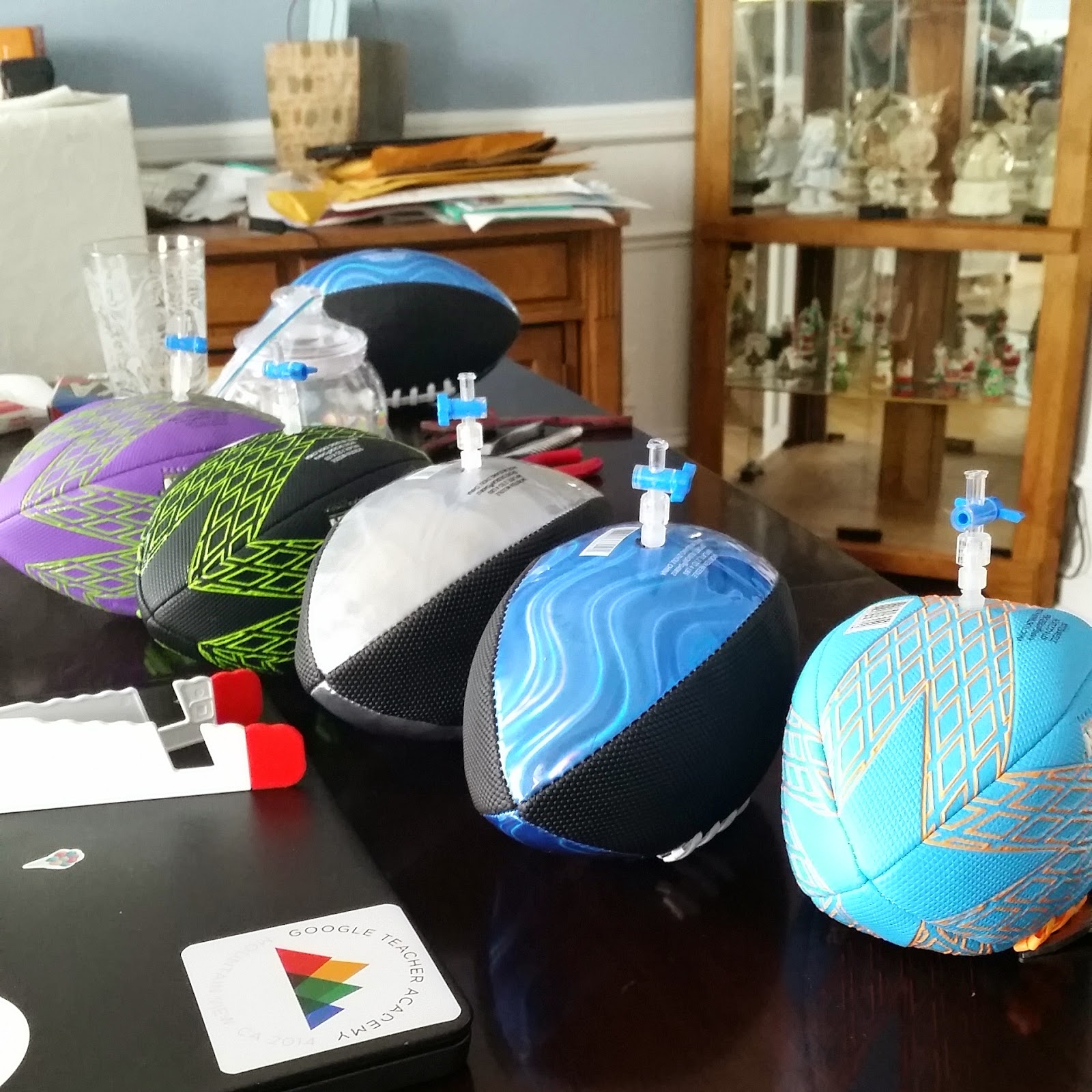
Mr. B and I brainstorm and come up with an idea about mounting a pressure gauge on a football and having the students immerse the ball in several water baths. We knew that the small change in pressure the footballs experienced wouldn't cause the almost 20% pressure drop caused at the game so we made the water baths go from over 100F to around 35F to have a more dramatic effect. After trips to Dick's Sporting Goods, Sports Authority, Five Below, Home Depot, AND Lowes, I found our original idea of simply installing a pressure gauge attached to a ball pin wouldn't work. I made some modifications and decided to add a Vernier Pressure Sensor to the footballs to give us better readings.  Here is a picture of the final setup:
This is the lab setup with the Vernier Pressure Sensor and Temperature sensor all attached to the football.
This is how I spent my weekend. Not pictured are the 3 footballs I destroyed trying to figure out how to remove the air valve. FYI, this was a lot harder than it seems.
I wrote up a lab experiment for the students to follow just so that we could have consistent results. I had some Gatorade containers like they have on the sidelines of football games for the hot and cold baths, and simply filled sinks for the room temperature baths. You can see the students holding the footballs underwater in each setup so that the air in the balls would actually change.
Room Temperature--approximately 23C

Hot Water--approximately 40C

Ice Water--approximately 5C
I ran the experiment with 6 groups in each of my 4 classes and NONE of the groups had more than about a 10% change in pressure and that was probably due to the fact that their valve was leaking and letting in water. We absolutely confirmed that Pressure and Temperature are directly related, but there was no way that only temperature caused the pressure in the Patriots' footballs to deflate.

Thinking forward to next year, there are a number of changes I need to make to the lab. First, my valves kept popping out which caused massive error. The valves definitely need to be sealed permanently into the footballs so that they can't leak. Second, I need larger containers for the water baths. Mr. B is going to try this with coolers instead and we think that will solve the problem. Third, since the plug on the football has a valve that will close to seal the air inside, I think I will have the students close the valve and move only the football to each station instead of moving all of the equipment. It became almost like a team-building exercise as they carried wires and probes and data measuring devices around the room.

Overall, this lab was a success. I loved that I planned this with a first year teacher. I loved that it had real world application. I loved that it was STEM driven. And I loved how it was real chemistry, but didn't feel that way to the students. It reaffirms my belief that we need less formal labs and more real-world activities for the students to be doing. I also love that it was messy because that's what learning truly is.

30 January 2015

Lucky Teacher

I have been very fortunate this year to have a fantastic group of students as well as a wonderful co-teacher. Every crazy idea I have had they have all supported 100%. I get up every day excited to go to work for the chance to work with these wonderful people.

My Honors students are exceptionally open-minded. I decided to do away with traditional notes for the Gas Laws unit and let them tell me what they know about the properties of gases. We spent about half of the block breaking through all the misconceptions they had about their world and it led to great discussions in both classes. Then we learned about the relationship between Pressure and Volume using pressure sensors and a syringe. They quickly understood the inverse relationship between the two properties and I was very satisfied with the lesson.

I planned on using the Gas Properties simulation from PHeT just to verify what they had discovered earlier using the pressure sensor. The sim was projected onto the board and I asked for a volunteer to go up and manipulate it. The student quickly figured out how to add gas and I asked the students to explain what they were seeing. The shouted out things like:
  • The molecules are constantly moving
  • They spread out to fill the container
  • They are all moving with the same speed
And while this is going on, the student at the board is playing with the simulation. She is moving the little man to change the volume and pumping in more gas. Well, that's the point where I was no longer needed in the room. The class began to yell out things they wanted her to do: raise the heat, lower the heat, pump in heavier things, blow the lid off, add tons of gravity. I had planned to use the simulation as the next class' lesson, but the students were so into what they were learning that I literally couldn't stop them. I tried to do it. TWICE. But I was completely ignored.

I sat down at a desk and snapped these pictures. 


Naturally others wanted a turn so we needed to rotate. I made whomever went to the board make a statement for the class to add to their notes on the topic. No PowerPoint, no outlines, no formal notes. In one block we covered an entire unit's worth of material. And the best part, every word is theirs. I told them nothing.

I am a really lucky teacher to work in a school that has amazing students that let me do the crazy things that I do.

27 January 2015

The Four Rules of Meetings

I get a lot of inspiration from Audiobooks I listen to while doing other things. This post comes from Bossypants by Tina Fey. In the book, Tina Fey talks about the 4 Rules of Improvisation. They are:
http://bit.ly/1uz7cQI

  1. Always Agree and Say Yes--Someone points their finger at you and says it's a gun. You say, No it's your hand. You have effectively killed the conversation.
  2. Say Yes, And...--Instead of saying No,-- say 'Yes. And it's the gun I gave you for Christmas last year!' Now you can go somewhere with this. Not only has the person pulled a gun on you, but ironically it's the one you gave him.
  3. Make Statements and back them with your voice and actions--If you ask questions, you put the pressure on someone else to come up with all of the answers. By making statements, you helping drive the direction of the conversation.
  4. There are no mistakes, only opportunities--you may not have meant to say or do what you just did, but now that you did, where are you going to take it?
I got energized listening to this list (which I have heard before, but it never lit the lightbulb). Let's take those 4 rules and apply them to your next faculty/department meeting.
  1. Imagine that your Principal announces that the school will be participating in a new initiative for the school year and no one groans or complains. Instead, they all nod their head and agree that this is something they could see incorporating into their classrooms.
  2. The Principal decides to let everyone discuss what he has presented for 5 minutes in small groups. You turn to the teachers around you and start brainstorming ways that you could see this working with your students. Then, you start adding other elements to it, putting your own spin on the foundation that has been set for you. You decide to work with another teacher to develop joint lessons because you have a number of common students on your roster.
  3. At the end of the meeting the Principal asks if anyone has any questions. You raise your hand and, instead of asking if it is ok to do something, you explain to the faculty what your small group had discussed and the methods you are planning to make this a success with your students.
  4. During the course of the next several units, you realize that you have left out some key parts of the initiative and need to change what you are doing for the next unit. You work with your supervisor to make sure all the changes you are planning better align and your students are open to the changes because you have been invested in it from the beginning.
I know that my example is that pipe dream situation for all Principals, but why is it a dream? Could these 4 rules be used in schools? 

Sorry, I violated Rule #3.

These 4 rules could be used in schools to drive everything we do from classroom management, to curriculum, to discipline, to department meetings, to club meetings. Think of the possibilities if you were never allowed to say No, and had to be open-minded to what someone else had to say, no matter how crazy (read awesome) the idea is.

25 January 2015

Flux

I have been very bad about posting updates from my classroom. I even signed up to do the blog challenge from #YourEduStory in an effort to force myself to write more and I still failed.

The first assignment was to pick the word that is going to define you in 2015. The challenge was a lot harder than I thought as there were a lot of words that came to mind. I have used Awesome and Audacious before, and while I still love and strive for those words, I know that I will not expressly be striving for either of those things.

I realized that the word that will probably best define my classroom will be FLUX.
When I first started flipping my classroom, I realized that I needed to radically change my thinking about how learning and grading occurred. Over the last 5 years, change has just become a constant for me. In the 2014-2015 school year, I have changed at least 1 thing about every unit I have taught in every course. It may be something simple like changing the HW set for AP, modifying the unit Test, or completely revamping the entire way the Gas Laws unit is taught (which I will write about next week after I try it).

While it is absolutely exhausting and I feel like I am in my first year of teaching all over again, it has also been exhilarating! When I sit with my in-class support teacher to discuss the frustrations I am having with our current system, I get so excited in developing something I have never tried before. 

The best part about having a classroom that is in flux is I have created students who are willing to take risks with me. They know that I am constantly changing class, always looking for improvements. Because of this they remain flexible and open-minded for anything that I might throw their way.

Flux is tough. I often get to the end of the week and think I should just drop all of this and just do it the way I have always done it. Then I stare at my empty classroom and reflect on all of my successes. That's when I realize I wouldn't have it any other way.

14 December 2014

MHSS TED Ed Club's #BookItForward

I haven't seen a Kid President episode in a while so the one below caught my attention when I saw it mentioned on Twitter.


Our TED Ed Club has changed focus this year and I feel we have lost a little of the magic that we had last year. In an attempt to regain some of it, I decided we are going to participate in #BookItForward with Kid President.

My idea is for every member of the club to find a book that has meaning for them. It might be something they love to read over and over; it might be something from their childhood; it might be something that someone important gave to them and they want others to hear the story behind it. Each person is going to write down on an index card why this book is meaningful to them and stick it somewhere inside the book. We are also going to add a letter inside explaining our project with a Book Crossing sticker to help us track how far the books go. Then the hard part comes: finding 30 people to send the books to.

I was debating whether this would be a good project when I happened to see this post from Nick Provenzano which confirmed for me that this needs to happen.

So, here is what I need from you, dear readers. I am looking for volunteers to receive books from my TED Ed Club members.  Send me an email (marcseigel@gmail.com) with the subject #BookItForward Volunteers and your address. I will pick a book from those my club contributes and send it to you. I will also post here thanking you for participating and the story behind the book.

Thank you, in advance, to all of you who volunteer!

29 November 2014

Batting 1000

Last night I attend the Class of 2004's reunion and had a chance to hear the AMAZING things my former students are doing. One (who we all thought we get kicked out of college) is now a lawyer, another is doing neuroscience research using ultrasound, another is helping design the new class of submarines for the Navy, another took one of the biggest leaps and is a stay-at-home dad. It really warms the heart of a teacher to hear when his students are living happy, fulfilling, successful lives.

As my wife and I were driving to the event, a thought popped into my head: how many students have I taught? This is my 15th year as an educator, how many lives have I directly impacted in my career so far?

When I was in high school, my fencing coach told me that he bought a yearbook every year for his entire career. He said that when he retires, he could look at the shelf of yearbooks and say 'this was my career.' He used to keep the yearbooks in school and, as someone who's dream it was to be a teacher, it was quite impressive to me. After 37 years, he retired and it took him 3 trips to his car to bring down all of the memories.

I have followed his advice and bought a yearbook every year of my career and, even though it was after 9pm when we arrived home, I pulled them off the shelf and started leafing through them. Armed with a neon green marker I put a dot next to each student I have taught. Nearly three hours later, I was at 777. Now, I know I definitely missed a few because I couldn't remember every single face or every name that I came across.

And I was disappointed.

Only 777? That couldn't be right. As I stood to stretch I remembered that I never counted the students in my current school that haven't graduated. Since I was only using senior photos (and occasionally junior/sophomore depending on the year I left the school) that meant I left out all of my students from last year and this year that haven't graduated yet. Add in another 226 and I was 1003.

ONE THOUSAND!!! I have taught one thousand students. One thousand different faces have walked through my door; one thousand butts have sat at my desks; one thousand lives I have had the chance to make a difference with; one thousand amazing people who changed me for the better.

The picture to the right is of all of my yearbooks and of my 'This Is Why I Do This' file. I keep every
letter, picture, drawing, card, etc. that is given to me by a student. When I have a really bad day--a day that makes me question why I became a teacher--I open this folder and leaf through all of the memories. It re-energizes, rejuvenates, and inspires me to keep bringing the awesome every day.

So, thank you to all my former and current students for being the amazing people that you are. Here's to the next One Thousand!

23 November 2014

An EdcampNJ Reflection

My wife and I are putting together a presentation proposal for the 2015 Flipped Classroom conference and decided to use EdcampNJ as the location for the trial run. Since she teaches Social Studies and I teach Chemistry many of our conversations are spent bouncing ideas for our classroom off each other because we approach the same problem from very different perspectives. This means that my projects tend to have a humanities feel to them and my wife's have a more scientific approach.

Through our discussions we realized that many teachers do not have these types of conversations on a regular basis because the people they interact with tend to come only from their department. There are great ideas and great teaching practices happening all over your building every day. How many of them are you aware of? Since Edcamp is based around conversations, we thought this conference would be the opportunity for everyone to come together to share their best practices related to The Flipped Classroom or to whatever other idea they wanted to discuss.

We decided to call our presentation:

Improving Your Practice, No Matter Where You Start:
A Flipped Classroom Discussion

We broke our slides into 7 parts:  Administration & Parents, Technology, Homework, Colleagues, Mastery Learning, Instructional Alternatives, and Assessments. These are the topics that come up the most often in flipped classroom discussions so we figured this would be a good place to start. When the session began, we explained our purpose, showed the 6 topics, and let the participants choose where they wanted to go. We figured that if people wanted to spend more time on one topic than another, we should allow them. It would also leave flexibility if the discussion headed down a different path than what we originally planned.

The presentation went fine. It wasn't great, but it definitely wasn't terrible. There were some really good parts of the discussion where we discussed PRIDE cards (cards given to every student so when they completed all of the tasks they received a reward), giving more praise and positive reinforcement in a flipped classroom than a traditional classroom, and Plickers.  There were a lot of great questions and we ran out of time before we covered all 7 areas.

The problems that we found was something we have seen at other unconferences, but can't figure out how to overcome. First, most attendees (especially first-timers) are not used to coming to a conference and having to engage in a discussion. They arrive with the expectation that the presenter is the expert and they are going to learn from him/her. Second, as teachers we are too used to dominating the conversation so it can be difficult to let others take control of the presentation. The first problem definitely led to us spending too much time talking. 

Overall, we felt this presentation had a good idea and format. We will probably keep the same format, but definitely need to work on how to engage more participants in the discussion. This will probably involve more methods of response such as Polleverywhere or backchanneling in a Google Doc or on Today'sMeet.

If you have presented at an Edcamp and run into the same problem with a lack of participation from the group, what strategies have you used to engage the audience?

Moving Day

I want to thank everyone who has been reading this blog. It is time to get a more professional look to the site so this blog will be moving ...