03 December 2013

You know who's awesome?

Ms. Flood is awesome!

My older son qualified for the 1st grade Gifted & Talented program; something both of his parents
participated in.  We were very excited because he earned his place due to his creativity and imaginative problem solving skills. It wasn't test scores nor teacher recommendation, but the traits we value most in our children.

Since the teacher is shared between multiple schools and my wife and I are both educators, we asked for parent-teacher conference outside of the normal scheduled time.  We feel it is very important to meet our children's teachers face-to-face.  Ms. Flood agreed to meet us, but the only available day was a Friday afternoon at 3:30.  +1 in the awesome column for a Friday afternoon conference.

Our conference lasted nearly an hour because my wife and I were fascinated by everything Ms. Flood was saying.  She tells us she threw out the curriculum because it didn't put enough emphasis on things like problem solving skills, collaboration, and creativity.  Right now they are designing their own lunchboxes.  They have to create blueprints, collect materials and physically build the entire thing.  Nothing is "HARD" in her room; everything is a CHALLENGE.  When someone is struggling, she has the other students help instead of the answer always coming from the teacher.  The homework is to analyze things in their own world to see how they can be improved upon and have more creativity added to the design.  These are engineering concepts the teacher is teaching them in FIRST GRADE!  +2 in the awesome column.

I tell Ms. Flood about the science demos I had done that week for my son's class and told her it would be great to partner on something for the entire first grade.  Since she has a background in science (that's right.  An elementary person with a real science degree) she was very eager.  Now we are going to create a STEM challenge night for parents and students that are going to involve a variety of engineering challenges throughout the school to emphasize everything that we both value.

My son has been very lucky in the teachers he has had over the past 2 years.  They are caring and creative educators who always put students first.  I know that won't always happen, but I am glad it has because he really loves going to school every day.

14 November 2013

The purpose of standardized tests

It was explained to me that the purpose of standardized tests is to measure a student's level of retention of material.

I don't disagree with this statement, but it shines a light on the fundamental problem and philosophy of standardized tests.  By default, this assessments can't require critical thinking or problem solving, and the primary skill a student needs to be successful is a strong memory.

Last year, a former student would use my room during lunch to tutor students in other classes.  One day, he was trying to explain how to solve a particularly difficult math problem.  One of the students in the group turned to him and asked him how he could possibly understand how to do this when no one else in the class did.  He said that when he was in my class, I had the students watch videos that explained topics in the class.  Whenever he doesn't understand what his other teachers are saying, he just goes on the Internet and finds other resources that explain it in a way he understands.

cenblog.org
To all my students who read this blog:  I am not preparing you to win at Chemistry Jeopardy.  Hopefully,
during our time together, I will help you develop the skills to solve problems creatively and, if nothing else, learn how to find the answers you seek.

Winning at Jeopardy doesn't prove you are smart.

Creating the show Jeopardy does.

23 October 2013

Best. Meeting. Ever.

We had another TED Ed Club meeting this afternoon.  These meetings always have 3 parts:  evaluation of our recent project, discussion about the newest TED Talk, and setting an agenda for the next meeting.  After school meetings are tough because so many students are involved in extra-curricular activities that they just can't find time for everything.  But, in the end, we had about 15 attend with a few of those arriving late.

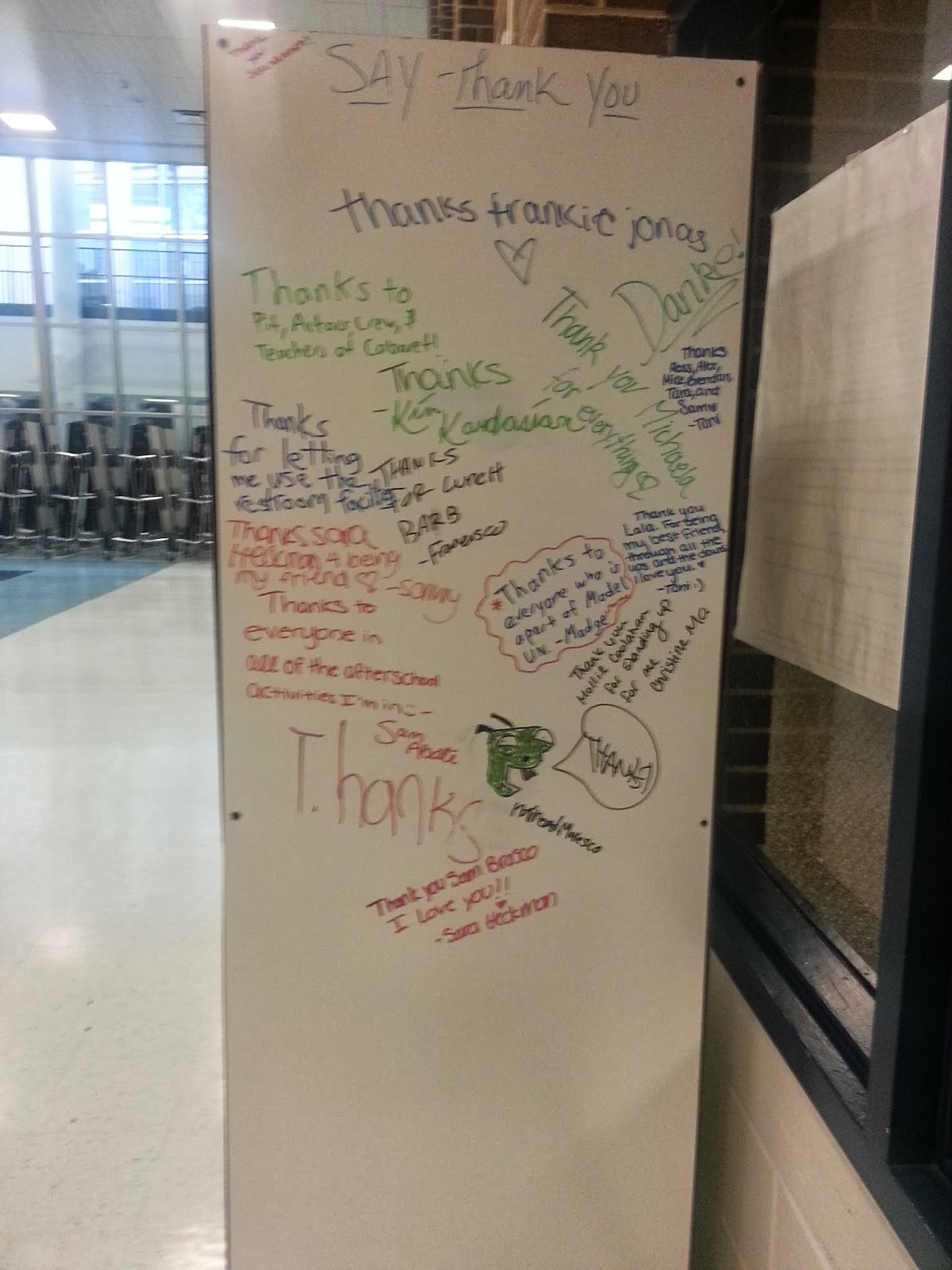
Our latest project involved what we were calling the "Thank You Wall."  Using the TED Talk by Drew Dudley as our inspiration, we decided to create a space for anyone in the building to say thank you to someone who had a positive impact on their life.  It was extremely well received as you can see from the pictures below.  The columns we created were 6ft tall by 2 feet wide so between the 2 of them there was 96 square feet of whiteboards filled with nearly 400 messages of thanks.


The project was headed up by one of our seniors.  He commented in the meeting that on one day he saw a girl glance up at the board, see a message that was written to her, and a huge smile broke out on her face.  He said right then it made all the planning and time worth it.

But what I really wanted to share was the discussion that ensued for the next hour.  The talk we chose was by Shawn Achor about what makes us happy.  There have been a lot of changes in our school/district, not all of which have been well received by the students.  I thought this video would be a chance for the students to get refocused on the important things in their life.


This discussion was intense!  I decided to try a new system and had the students write down their comments on post-it notes and stick them to their faces whenever they had something to say.  We have a tendency to get very passionate and talk over each other so this was a way for us to stay organized and keep track of our next comments.  Students had 3 and 4 notes stuck to their face, they are standing on desks trying to be recognized next.  Two girls who are best friends got into a huge argument over the ability to have selfless acts.  It was amazing!!!  I have never seen students debate so adamantly before over something that was, in reality, so trivial.

In this whole discussion, the students decided that we needed to have a better focus, a mission statement to guide us in our future meetings.  Here is what they came up with (I had no part in this at all!):

Objectives of the MiddSouth TED Ed Club:
1. Make a positive impact on the school community
2. Do something to benefit others
3. Change the way people treat each other.
4. Create a bonded community.
5. Make a change in ourselves.
6. Do something that other schools don’t.
7. Provide a forum for unique ideas that have nothing to do with what happens in the classroom.
8. Put ideas into action.
9. Bring our ideas to younger kids.

In all the years I have been an advisor, I have never seen a group of students so excited at a meeting. I can't wait until next week's meeting and I wish it wasn't only 30 minutes long.

26 September 2013

I'm excited

This year is going to represent one of my biggest challenges.  I'm going to be teaching over 140 students in six sections of chemistry.  Now I understand that there are English teachers, social studies teachers, gym teachers and I understand that grading an essay can take a long time.  But there's one thing a chemistry classroom has that other classrooms and that's labs, lab safety, and fire.  My sections are all over 20 kids several of them over 25 students in a classroom.  Again I know there are teachers have a fire worse, but I've never had it like this and to be honest I'm a little scared. I've never tried to run chemistry with so many studentsl; I'm scared of the number of assignments I am going to have to grade.  And, most of all, I'm scared that I won't be able to be as innovative or creative as I want to be. I've been dwelling on this for the past couple of weeks and I realized, once again, I need to take a different approach. I need to look at this from a different perspective and I don't mean flip the class.  I need to focus in on the things that get me excited every day so here's why I'm excited to start this school year:


  1. I am excited to start my 14th year in education.   I know there are a lot of teachers who have far longer careers, but there are a lot that never get that far.  But, I'm very proud of the fact that I have been an educator for 14 years and have had a successful career.  
  2. I'm excited to have more students than I ever before because it gives me a chance to have a positive impact on more people.
  3. I'm excited to get more students excited about chemistry and have them view the world through chemistry colored glasses.
  4. I'm excited to see kids learning with technology.  I have discovered some great tools this year and can't wait to expose them to some fantastic ideas.
  5. The more students I teach the more that I have a chance to connect with through social media.  That means building stronger relationships than I could when I first started teaching.  
  6. I'm excited for my TED Ed Club. I'm excited that we have the opportunity to be one of only 25 groups in the world that got a chance to pilot this club.   I'm excited to have them looking at videos they didn't know were out there and I'm excited to connect them with partners all over the world, from Colorado to Texas to Algeria to Queensland, Australia.
  7. I'm excited to be part of the Technology Committee which is going to rethink how the district is going to handle technology integration.  Basically, we are going to Google the crap out of everything. We are going to help students learn using mobile technology and how to make learning happen on their time, in their own way, using cell phones, iPads, Chromebooks, and GAFE.  
  8. I'm excited that my principal and my supervisor trust me so much that they let me run my classroom the way that I feel is best for my students. I'm excited that my principal trust me enough to let me be involved in the the planning of new teacher orientation and training across the district.
Note:  I wrote this several weeks ago and wanted to let it steep in my brain.  Well, I completely forgot to post it.  It is a little rough because I don't remember how I was going to conclude it.  But I still wanted to get it out there.

20 September 2013

Piloting a TED Ed Club

Back in June, I stumbled across this website on Twitter from TED Ed.  I show TED Talks in my chemistry class, occasionally for chemistry, but mostly just to expose my students to innovative ideas and a different perspective on the world.  A few days after submitting the survey, I received an email from TED telling my that I have been selected to be one of 25 pilot clubs from around the world.

There were 2 choices for the type of the club:  Discussion or Presentation.  Since I received the email on the first day of summer vacation, I chose the discussion format.  I figured that we could treat the club similar to a book club, but we would be watching videos instead of reading chapters from a book.  I sent an email to every student I had had over the past 2 years and a few colleagues posted it on their class Edmodo sites.  In the end I had 12 students sign up.  We met in the public library, classrooms, and a Panera.  The discussions ranged from creating situations of absurdity, alternative fuel sources, what constitutes beauty, and a theory of everything.  The discussions went in every direction and it was amazing to hear what the students had to say.

The most fascinating aspect of the club was the type of student who came to the meetings.  Almost all of the students are those that you might classify as "wallflowers."  They are excellent students who would prefer to sit quietly in class and complete their work rather than answer questions or have any attention drawn to them.  However, pull all of these students out of the classroom, give them a non-school related topic to discuss (that actually interests them), and suddenly they won't be quiet.  Our meetings ran over time every time because the discussions were so interesting.

So fast forward through the summer and we were selected to continue our pilot through January.  While I really enjoyed the discussions, I couldn't see us meeting for another 5 months and continue with the same format.  I was on a family vacation in Portland, ME and my wife starts eagerly pointing at the wall of a restaurant where I see "Before I die..." painted on top of black chalkboard paint.  Then, along the wall people wrote in things they wanted to do in chalk.  Apparently, this is based on the TED Talk by Candy Chang.  And that's when the lightbulb went off.  All of the newer TED Talks have some sort of profound message, what if we create student-driven projects centered around this message?

One of the concerns I have is that my students are going through school without really knowing the people in their classes.  I wanted to create a project that not allow students to feel connected to others around them, but also increase school spirit (something we are really lacking).  Today was our first home football game and our fans are called the MiddSouthNation.  So I printed out 3000 of these stickers
and starting at 6:30 in the morning, members of the TED Ed Club started handing out stickers to every member of our school:  parents, students, staff, cafeteria workers, custodians, bus drivers.  We also contacted our Touchdown Club to get the giant inflatable South Eagle mascot for the front entrance.  Have you ever seen kids getting excited to be at school at 6:30am??  Me neither, but these kids sure were because they were engaged in something meaningful to them.

So the MiddSouth TED Ed Club has become a community impact club.  Our purpose is to use the profound messages from TED Talks to create student-driven projects that help our community see the world just a little differently. Every student wasn't wearing a sticker and many didn't really understand what we were doing.  But, the staff were smiling a little more today than yesterday, several hundred students were more involved in school than yesterday, and we increased attendance at the football game.

I can't wait to see what our next project entails.


22 August 2013

Rolling on Chrome

My colleagues call me Mr. Google because when someone comes to me with a technology problem, my answer usually has something to do with a Google application.  I mean, their products do everything short of making your dinner and walking the dog so I use it whenever I can.

While at the Greater Clark County Conference in Indiana, I saw the release of the Chromecast and knew it was exactly the device I needed to get my hands on.  Here is a picture of the moment it arrived

In a nutshell, the device connects to the HDMI port of a projector or TV and allows you to send what is in your Chrome browser to the TV over the local Wifi.  Currently I use a Warpia VGA to USB wireless adaptor to transmit my computer screen to the projector in my classroom.  While this device works well for general use, one of the downsides is that everything that is on my screen ends up on the projector.  The Chromecast app allows you to connect a single Chrome tab and then work on anything else on your computer.  A huge benefit to teachers who might to show a slide show or video, but then work on sensitive information (emails, grades, etc.) at the same time.  While showing videos in class, my wife backchannels with the class, posing questions and engaging in discussions.  Her district no longer uses DVD players since every computer has a DVD drive so this allows her to do both tasks without interrupting the students' attention.

After installing the Chromecast app on the computer, an icon appeared on my extensions bar in Chrome,  This allows me to instantly display the tab I am on in seconds.  YouTube and Netflix have been modified also with Chromecast buttons that will display the videos in full screen automatically.  The one major downside it the device only works with Chrome.  You can't display any other software or browsers.  Great for doing presentations on Google training, but not for my every day teaching. (oh and great for parents who can now show Netflix on a TV in a hotel room while on vacation!)

So that was July.  August rolls around and I stumble across a $30 coupon for a Samsung Chromebook available for 1 day only.  I think it took about 30 seconds before my car keys were in my hand and I was out the door.  It turns out Staples only had 1 left and it was an open box (which always makes me nervous), but after 2 coupons and a discount for the open box, I was walking out with a new computer for $50 less than listed.

So the Chromebook.

If you don't know what it does, you are living under a rock.  The device runs Chrome OS and needs an Internet connection for most of its functions.  While it will work offline for several Google Apps, it really needs Wifi to be more than a shiny paperweight.  I can't foresee giving up my laptop for teaching and everyday use, but I am not likely to be carrying around a heavy laptop to meetings or lunch duty.  The Chromebook feels like it weighs nothing and is smaller than a paper notebook.  I have to say that I am definitely in love with this device.

11 July 2013

Left us wanting more

The College Board decided to change the AP Chemistry curriculum and exam.  The entire course is shifting toward specific Learning Objectives and guided-inquiry lab activities.  The exam has fewer questions which require more application of knowledge than pure recall, and emphasizes students analyzing pictures and word expressions for chemical processes.  The whole shift is actually really exciting and will fit very much into the philosophy I have for my classes.

In order to get better prepared for this paradigm shift, I registered for an AP Summer Institute (APSI) at Rutgers University, which happens to be 4 miles from my home.  This will be my 9th year teaching AP Chemistry and my scores are primarily 3 or above so I was looking for three things: a better understanding of how the exam was structured, how to incorporate these 16 labs College Board wants us to use, and how to get my students' scores to the next level (3s turned to 4s, etc.).  What I got was something very, very different.

I was originally writing this post as a way to get my thoughts in order before I send a disgruntled email to Rutgers and the College Board about the lack of preparation this APSI provided.  Then I remembered my goal here: to flip the way I see the world.

Now, there is no way I can put a positive spin on this experience.  There was a tremendous amount of time where I was not engaged in the learning which meant I could better reflect on learning that occurs in the classroom.

  1. Lecture really doesn't cut it anymore.  It doesn't matter how amazing and entertaining you are, today's learners have far too many other things going on in their brain to listen to long lectures.  There are distractions on their phones, computers, lives that are keeping them from devoting the amount of energy toward focusing on learning your content.  There needs to be engagement of the learners.  This may mean small group discussion, organized large group discussion, hands-on activities, analysis of a reading passage.  Really anything that gets the brain actively involved is important.  While I was taught in a time where you could get away with lecturing for 45-60 minutes (and it happened often) today's brains are used to multiple stimuli.   They also have an unbelievable ability to multi-task and teachers need to remember that just because someone isn't paying attention, doesn't mean they aren't listening.
  2. Differentiation is extremely important.  It doesn't matter if it is the main lesson for the day or the lab activity that you are about to complete as a class, if you have students who are advanced and want to move forward without you, don't hold them back.  The teacher used to be the authority in the classroom and students were told to respect the teacher no matter what.  Now, you have to earn that respect on a daily basis.  Unfortunately, that's not the hard part.  The hard part is when the teacher has to re-earn that respect after it is lost by saying/doing something that offends the students.
  3. Remember that no matter what you are teaching every student, every day.  It doesn't matter if the student asked the question or not, if the person is on the right side or left, front or back, or if the person is even in the classroom.
  4. Students need to be respectful of each other as well as the teacher.  Students can't be disrespectful of the learning of others.  But, those who feel disrespected cannot be rude is return.  You need to speak up about what is happening and the teacher needs to regain control of the learning atmosphere.
School needs to change. I wish I had the exact recipe to make that happen, but things definitely need to be different.  But, I can only do so much.  I fell more importantly that I need my students to want the change, embrace the change, and help me make the change too.

Moving Day

I want to thank everyone who has been reading this blog. It is time to get a more professional look to the site so this blog will be moving ...